Working with Ross Geller in Therapy Using Acceptance and Commitment Therapy
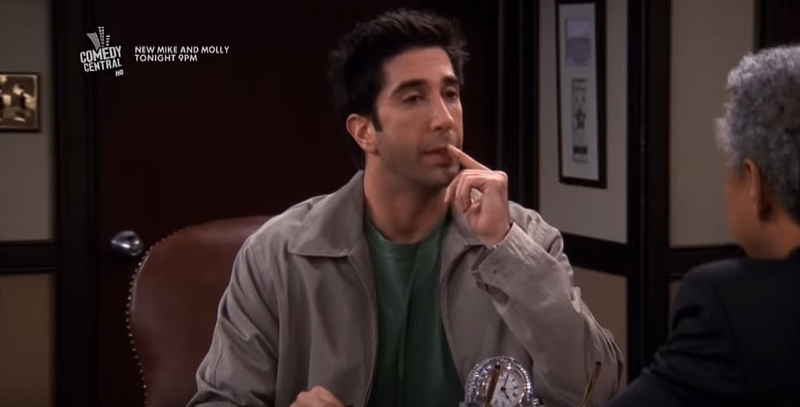
Ross’ divorce lawyer once suggested that he consider therapy, but he never did. This essay examines the “what if” scenario of Ross seeking therapy, including how ACT may help Ross, and detailed treatment plan.

The following is a final report written for course CPSY 218 - Foundations of Psychotherapy and Personality - at Santa Clara University while I was a graduate student in the Counseling Psychology program in 2020.
Ross Geller from the 1994–2004 NBC sitcom Friends is an iconic character that brought many laughter (and some tears) to audiences worldwide. Ross’ plight of an on-again off-again relationship with another main character Rachel, along with his three marriages and divorces, are running jokes throughout the show. I first saw Friends in 2006 to learn American English and culture before moving to the U.S. for college. Thanks to all that the show has to offer — humor, comfort, ridiculousness, and heartwarming friendship — I have seen it many times since then; each time, new insights emerge. In regard to Ross, at one point in the show, Ross’ divorce lawyer suggested that he consider therapy, but he never did. This essay examines the “what if” scenario of Ross seeking therapy instead.
Ross’ Relationship History
Born in 1967, Ross was raised in Long Island, New York. His younger sister, Monica, is also one of the six close friends in the show. Ross and Monica grew up in an overall healthy upper-middle-class Jewish family. In fact, their parents — Judy and Jack Geller — remained happily married into Ross’ and Monica’s adulthood, while all four other friends (Phoebe, Rachel, Joey, and Chandler) survived turbulent parental situations such as divorce, affairs, or suicide.

Ross’ career trajectory was overall stable. He studied Paleontology in college and proceeded to obtain a PhD. He then worked at the Museum of Prehistoric History for five years before becoming a professor at New York University.
In contrast to his steady professional path was his volatile “love life”. The series began in 1994 when Ross was 27 years old and had just divorced his first wife of seven years, Carol, after Carol realized that she was a lesbian. The end of the marriage with his first love upset Ross to his core, especially as he highly values marriage, commitment, and heterosexual family structure. About a year after his divorce, Ross and Rachel began a relationship, which ended on its one-year anniversary after escalating fights, mistrust, and an affair stemming from a misunderstanding. After briefly getting back together with Rachel, Ross met his second wife, Emily. Unlike his first marriage, the second one was the result of a few weeks of passionate long-distance dating and Ross’ declaration of “It just feels right!”. Not surprisingly, it ended rather quickly — Ross made an unintended but fatal mistake at his wedding, leading to explosive mistrust, misunderstanding, and his second divorce.
Ross was devastated. He underwent several life changes as a result of his divorce from Emily, including getting evicted and having to take a leave of absence from the museum due to his angry behaviors at work. In summer 1999, about six months after his second divorce, the group went on a trip to Las Vegas, where Rachel and Ross, still friends, drunkenly married in a hotel chapel. After they realized what they did, they agreed to file an annulment, before their friend Phoebe bluntly proclaimed “Oh that’s your thing! You are the guy who gets divorced.” All other friends jokingly nodded. Ross protested, “That’s not my thing! I do not love getting divorced”, only to be followed by “Yes you do! This is your third divorce!”.

After such a humiliating exchange, Ross could not stand the idea of divorcing for the third time at such a young age. After coming back to New York from the Vegas trip, he kept telling everyone “I’m not gonna be that guy!” or “I don’t want my tombstone to read, ‘Ross Geller: three divorces!’”, even after Rachel explained to him what a terrible idea it was for them to stay married, and urged him to file an annulment. In an ill-advised attempt to protect his friendship with Rachel and avoid another divorce, he lied to her that he had taken care of the annulment. Highly sensitive at this point, especially after Phoebe suggested that he stayed married to Rachel because he still loved her, Ross visited his divorce lawyer to prove Phoebe wrong. He ended up learning that both people need to testify before a judge for an annulment to be granted. Having already lied to Rachel, Ross asked, ridiculously, “What about someone that looks like Rachel?” The lawyer suggested that Ross consider therapy.
Ross’ Cognitive and Behavioral History
Assuming that Ross decided to enter therapy with me, my chosen point of view is the cognitive behavioral approach, specifically, Acceptance and Commitment Therapy (more details below). Ross’ experience with intimate relationships between age 27 and 31 gradually chipped away at one of his core values of being in a committed and trusting relationship. Instead, each significant relationship of his during this time was short-lived, and filled with misunderstanding and miscommunication. In the meantime, he developed an increasing number of unhealthy, unhelpful, and inflexible cognitive patterns that ultimately led to his current state of lying to one of his closest friends about a sensitive issue that impacts both of them. As such, breaking down some of his rigid cognitions and negative self-talks that guided his problematic behaviors may help him look at his current attitudes and feelings towards relationships in a healthier light, hopefully bringing about behaviors that are more aligned with his core values.
Looking at Ross’ cognitive history, his divorce with Carol after a seven-year marriage left a deep scar, especially because Carol found out that she was pregnant with Ross’ son in the midst of that divorce. Without this turn of event, Ross could have had everything that he was looking for in a relationship: a committed marriage with a woman he loves and children of their own.
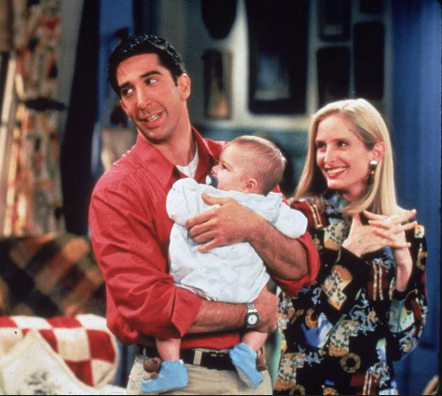
Gradually, Ross turned less trusting and more neurotic as he began dating Rachel. Ross developed an infatuation with Rachel in high school but never revealed his feelings. When they reconnected in their mid-twenties and became close friends and lovers, Ross was naturally overjoyed. Ross loved her very much, but combined with his growing insecurity around relationships, in order to protect what he had with Rachel, he engaged in some self-defeating behaviors that pushed Rachel further away.
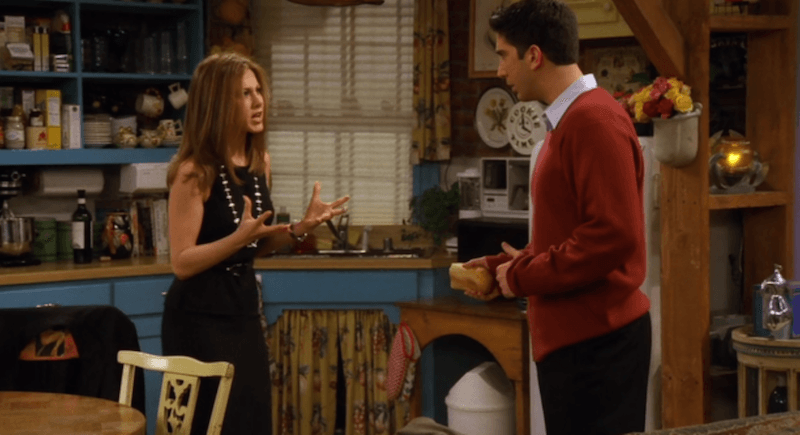
For example, Ross suspected that Rachel was cheating on him with a new coworker Mark, whereas Rachel simply was thrilled to have a mentor at her new job. When Ross apologized, his words revealed his changed cognition before and after his first divorce: “This whole Mark thing is really hard for me. I was with Carol for seven years and I lost her. And now if it’s possible I think I love you even more. So, it’s hard for me to believe that someone else isn’t gonna take you away.” The distorted cognition of “something bad is going to happen” clouded Ross’ judgement and narrowed his vision to all the “signs” that pointed at an impending doom. A series of mistrust and misunderstanding based on Ross’ increasing obsession with protecting his relationship with Rachel at the slightest hint of Rachel “slipping away” (a new job, new coworkers, less time with Ross, etc) eventually led to their breakup. Ross’ worst fear and fixed belief that “something bad is going to happen” was still realized.
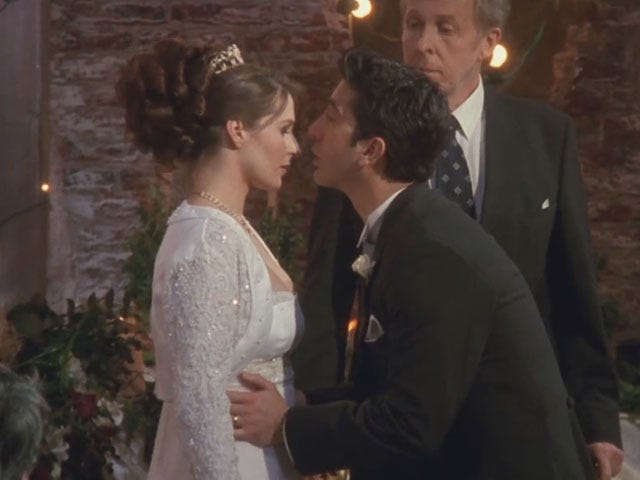
The lightning-fast second marriage of Ross’ revealed to him a refreshing possibility of regaining what he had lost: a long-term relationship full of romance and commitment. The fact that Emily lived in London further pushed Ross towards marriage after just a few weeks of dating, so that they could be together in one place for the long haul. Unfortunately, due to a lack of trust-building over a period of time and a misunderstanding, Ross’ mistake at the wedding amplified Emily’s mistrust towards him. Ross tried everything to save the marriage, even accommodating Emily’s unreasonable request for him to stop seeing all his friends. Again, Ross behaved according to his life experience and core belief about marriage: Marriage is important, and it takes a lot to make a marriage work. He valued marriage so much that he did everything he could to please a hurt Emily so that she would fly to New York and be with him. Both of them soon realized that no matter what he did, Emily still could not trust him. The second marriage ended over a phone call between London and New York.
Given Ross’ deteriorating mental status after divorcing Emily, it would be sensible to consider that six months later, during the trip to Vegas, he was still healing from the loss. He was no longer working at the museum due to his “rage” (in fact, about a month after the divorce, Ross’ boss referred him to a psychiatrist), and he had been in a “floating” state for a while, holding anger towards both Emily and himself. Instead of processing his pain in a healthy way, Ross decided to drink an enormous amount of alcohol with Rachel during their first night on the trip, leading to a “drunken mistake”.
At this point, it was no longer about whom Ross divorced, but simply the very concept of divorce itself. His rigid cognition of “I’m not gonna be that guy” and “no no, I do not want three failed marriages” (even though the third one was never substantive to begin with), coupled with his negative self-talks such as “my life is an embarrassment; I should live under someone’s stairs” and “I won’t have a life or go on dates anymore; I’m at the bottom of the dating barrel now”, all put Ross in a miserable place. His positive qualities as a person — smart, handsome, and sweet — all turned invisible to himself. These were the very thoughts that led him to lie about the annulment, which soon backfired in his face (Rachel did find out later).
As previously discussed, Ross was raised in a traditional upper-middle-class American family, had a stable career in the field of science (aside from his leave of absence), identified himself as heterosexual, and valued marriage and conventional family structure greatly. He once expressed, despite all the divorces, “I love marriage and being that committed to another person.” His “three failed marriages” therefore were particularly painful for him, as they were the opposite to his values. As a result, Ross did whatever he possibly could to not be divorced for a third time, because to Ross, divorce was bad, and three divorces before age 32 meant “no more life and relationships going forward”.
Ross in Acceptance and Commitment Therapy
In therapy, my overall plan is to employ Acceptance and Commitment Therapy to help Ross:
- distance himself from his thought patterns and negative self-talks, and
- align his behavior with his core values of having a trusting and committed relationship.
First and foremost, creating a safe environment for Ross to talk about his challenges is of utmost importance, especially as Ross’ six close friends can sometimes add insult to injury (for comedic effect). In my view, positive change for Ross is not only possible, but inevitable, and I am glad that he entered therapy to explore a different future not so tied to his three divorces, but more to his potential as a loving partner in a healthy relationship. Deep down, Ross knows where he wants to go and what his goals are according to his values; he may just need some help to consciously realize that he can get there. Such a stance from the therapist aims at helping Ross move beyond his limiting self-talks and find hope that he still can “have a life and go on dates”.
Therefore, before implementing any therapeutic techniques, I will first take an exploratory approach to carefully listen to Ross, follow his narratives, and pay close attention to certain dysfunctional thought patterns and self-talks. These are not difficult to find — Ross came into therapy because he was deeply troubled by his divorces, lied to Rachel as a result, and thought that no one would ever date him again. He expressed his profound concerns and shame over his life as “an embarrassment”, and was clearly distressed about how to tell Rachel about his lie. Through reflecting thoughts, feelings, and experiences, I will let Ross talk more actively first, likely also about his past relationships, so that both he and I can obtain a fuller picture of some of his cognitive and behavioral history around relationships.
As ACT begins, the therapeutic process will switch to a more therapist-directed one, but remains collaborative. Given the nature of ACT, the focus will be on the present and the future. However, allowing Ross to talk about his relationship history in a safe space will be an opportunity to peek into the past as well, exploring how his current cognitions came into being.
ACT for Ross will first help him defuse from the alarming voices of “Three divorces!” and his firm belief that he will fail as a person with no life and no relationships because of his divorces. By distancing himself from his thought of “my three divorces mean I’m a failure”, Ross may loosen his tight grip on such a thought, instead of believing it as an objective truth. The objective truth is that, indeed, Ross is about to divorce for the third time, but the cognition of “then I will be a failure” is not necessarily a fact; similar, the “Three divorces!” inner voice may become less threatening to himself.

A few cognitive defusion techniques may be utilized, such as having Ross picture the thought of “I am a failure and embarrassment because of my divorces” and notice where it is located in space (Harris, 2006). Ross may be asked to describe his detailed observation of the thought, like a scientist that he already is. Alternatively, as one of Ross’ favorite game show hosts is Donny Osmond, we can consider having Ross imagine the thought said out loud in Donny’s game show voice (dramatically upbeat). The goal is to transform the thought into something more distant and less impactful.
The thought itself may inevitably provoke unpleasant feelings such as shame, anger, nervousness, and even despair. Accepting these distressing feelings while still living a rich and meaningful life is the goal of ACT (Harris, 2006). To bring these feelings to the here and now, so we can learn to accept them in therapy and beyond, I may guide Ross to imagine being on a date, and the topic of past relationships comes up. Ross may begin feeling apprehensive and ashamed. In that moment, I will ask Ross to observe these sensations curiously, and try to locate where he feels them in his body. With no rush (as Ross, when flustered, tends to blurt out things that he does not intend to say), I will ask Ross to take a few deep breaths to “make room for” (Harris, 2006) these negative feelings, letting them be there without struggling with them. Ross will also receive the homework assignment of taking deep breaths when these feelings surface in his daily life, perhaps the next time he is on a date.
Ross has a lot to give in relationships as a loving partner. If on his next date, all he thinks about is how embarrassing his divorces are and how much of a failure he is, he will have a difficult time accessing his charming and intelligent self, and enjoying the pleasant company of another person. The richness of the interaction will be lost on him. Practising being in the here and now in his daily activities (i.e., still “have a life”, in Ross’ own words) can help him better engage with the experience of living, from as minute as washing hands to as significant as going on a date for the first time after his third divorce. In the situation of a date, the goal is for Ross to fully engage in the exchange, focus on the other person, and respond to her accordingly, instead of being consumed by his own thought of “Three divorces!”.
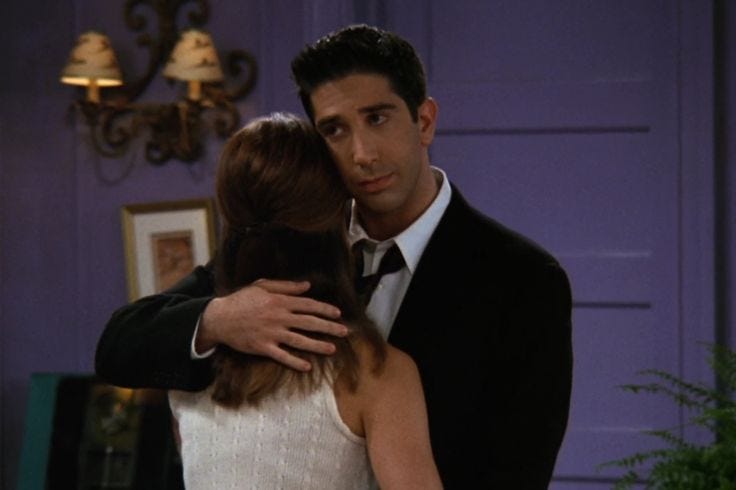
As Ross becomes more at ease with his reality, thoughts, and feelings, the next step in therapy is to clarify Ross’ core values and commit to actions that align with them. Ross’ core values are clear to himself — he wants a healthy long-term marriage with a woman he loves. Given his relatively stable upbringing in a traditional family of four, and the fact that he is the first in the friends group to have married and become a father, he longs for building a warm family of his own for his wife and children. To get there, we may have Ross set goals that he will commit to first building healthy relationships with those around him.
Given the current state of affairs, the first goal might be to apologize for lying to Rachel, sincerely. As he is on a leave of absence, he can also commit to reaching out to his boss and coworkers and apologizing for his angry behaviors at work, in order to return to his full-time job at the museum. A positive chain of events may ensue, including engaging in activities that he is passionate about (scientific work), being able to afford a new apartment thanks to regular income, and taking better care of himself health-wise.

Beyond ACT, Ross may also benefit from communications skill training to more effectively address miscommunications and misunderstanding, an ongoing pattern in his recent romantic relationships. Thanks to Ross’ solid support system of close friends and family nearby, there is hope for Ross in accepting the divorces and the unpleasant feelings that come with them, and committing himself to creating the life that he truly wants. In time, Ross may even find humor in his life experiences, thanks to the creative techniques of cognitive defusion and his own healing process (In fact, Ross was indeed able to do so later in the show; he once facetiously asked his friends, “What do you think about ‘Ross: the divorce force’?”)

Other Therapeutic Approaches for Ross
Lastly, after elaborating on how ACT can help Ross, other therapy approaches may be useful for Ross to consider.
First, to help Ross identify certain irrational, self-sabotaging beliefs around his divorces, Albert Ellis’ Rational-Emotive Behavioral Therapy (the AB-C model) may be applied. I may offer both approaches to addressing his dysfunctional cognitions, and observe how each approach resonates with him. Ultimately, it is Ross who takes what he gains from therapy and applies to his life in a way that suits him.
In addition, in season one’s very first scene involving psychotherapy, the show featured an intense therapist who clearly subscribed to the psychodynamic points of view. Roger, the psychiatrist, was dating Phoebe at the time, and was depicted as an incessant “analyzer” of the group. When examining Ross’ divorce from Carol, Roger claimed that Ross married Carol despite knowing, albeit unconsciously, that she was a lesbian, perhaps because he wanted his marriage to fail, “maybe to compensate for overshadowing a sibling… it’s conceivable that you wanted to sabotage your marriage, so that the sibling would feel like less of a failure in the eyes of the parents.” Indeed, Ross and his sister Monica have had a competitive relationship since their childhood, and Monica has always felt that her parents like Ross better than her. With these and more details about Ross’ childhood experiences, either individually or within the family system, a psychodynamic and/or family therapist may be able to help interpret Ross’ adult relationship challenges from different perspectives.
References
- Harris, R. (2006). Embracing Your Demons: an Overview of Acceptance and Commitment Therapy. Psychotherapy in Australia 12(4): 2–8.
- Crane D., Kauffman M., et al. (Writers), & Bright K., Halvorson G., et al. (Directors). (1994–2004). In Bright K., Crane D., and Kauffman M. (Executive producers), Friends. New York City, New York: National Broadcasting Company (NBC).