Dreamscape: Part 4
Just a few weeks before, the baby we were about to lose continued to grow and demand energy from the mother’s body. We ate all around Chinatown, Nob Hill, and the Embarcadero. Splurged, more precisely, as if the floodgates were open.

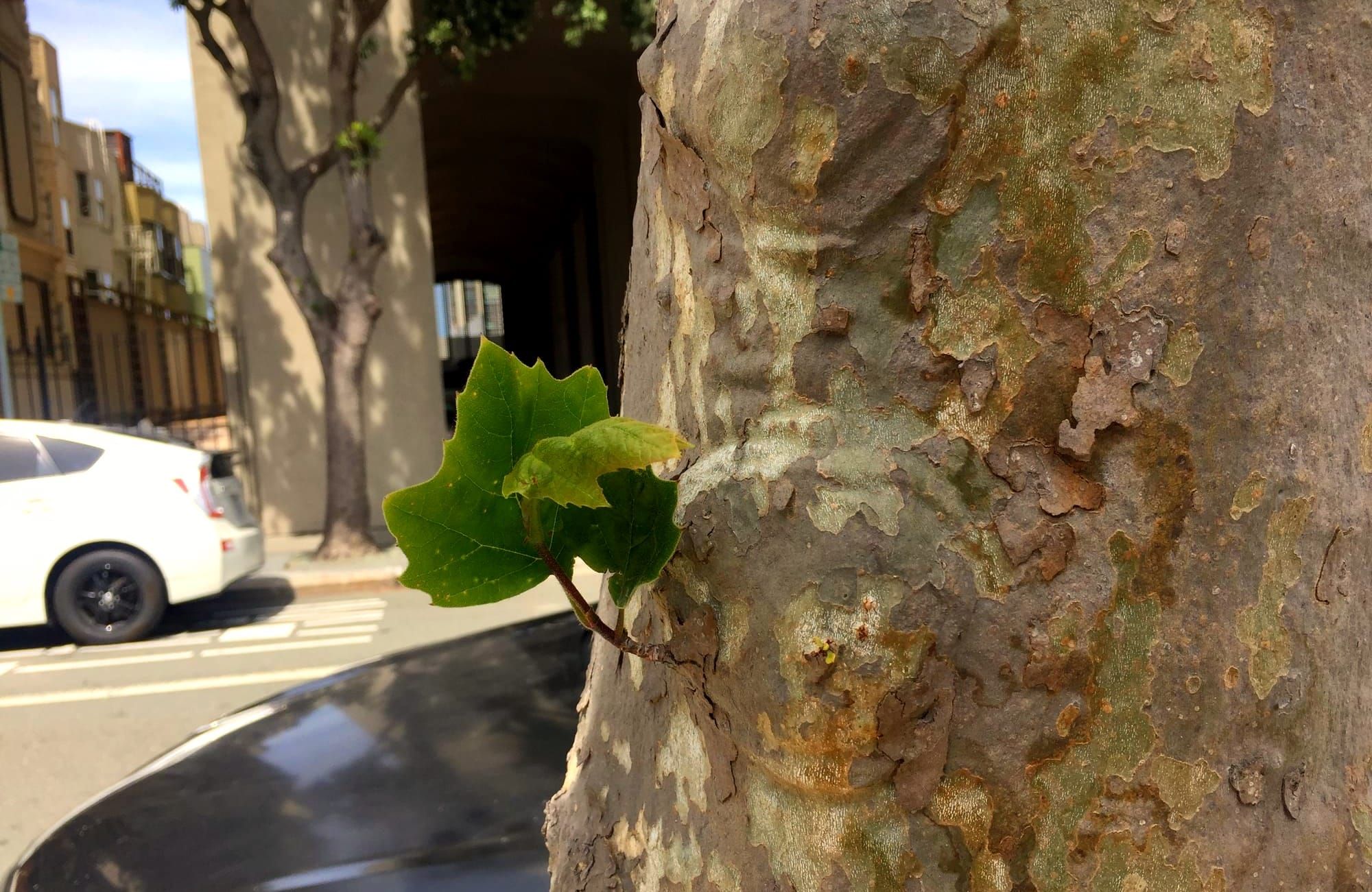
Dreamscape is a multi-part love letter from a transplant to the city of San Francisco, especially its people and beauty in the 2010s—conventional, absurd, or otherwise. How many parts? Still TBD. Read Part 1, 2, and 3 here.
Suggested music for Part 4: I Forget Where We Were
The sprawling sweet potato plant revealed its first and only flower bud on an unassuming Wednesday night. Nestled in layers of lush green leaves, the pink bud stood tall and proud, leaning toward the bay window of our Financial District apartment, poised to unfold at any moment. A year and a half into the pandemic, our new pastime of growing indoor plants had blossomed into a ritual of sorts, a practice, and dare I say a preparation.
Just before sunrise the next day, there it was—a full bloom, open wide, its five petals aligned perfectly into a trumpet-shaped pink flower, framed by the vibrant leaves that resembled jazz hands. Soaking in the morning sun, the plant seemed to be performing an epic show to celebrate its next stage of growth, no matter how brief.
The bloom lasted for only a few days, during which an embryo quietly implanted itself in the mother’s womb. She would only know the following week, stunned and elated. No amount of tending to indoor plants could have prepared her.
The single precious sweet potato flower disappeared as quickly as it arrived. We nonetheless packed up the plant as we moved out of the Financial District apartment complex, a well-loved home of four years. A seemingly more sustainable living situation had surfaced, a cheaper two-bedroom unit in a triplex building located on the border between Nob Hill and Chinatown. Owned by a Chinese American mother-daughter duo, the triplex stood steadfast on the Powell Street slope as the lovable cable cars ran right outside from 7am to 11pm daily. We discovered only after moving in that the double-pane windows were insufficient, the traincar-like interior layout not our cup of tea, and the move an overall unwise one amid a pregnancy.
But the landladies were attentive. The daughter never pulled our credits or ran background checks. “You meet potential tenants, and you just get this feeling that they’d be good” was her explanation. The mom offered us Chinatown hot food on our move-in day as her daughter exclaimed, “She’d do anything for tenants.” Despite the noise and frequently malfunctioning wall furnace, we paid rent via Venmo and moved closer to one of our grocery sources (Chinatown).
Two months after moving into the triplex, our daughter died—a precious first child. The triplex was too narrow to hold all the grief and anger from the loss; the warm welcome of the landladies did little to wipe away all the tears shed in that house.
The three short weeks of blissful ignorance before my daughter’s diagnoses offered us a small buffer to settle into the new place. But no amount of 2020 Summer Olympics games energized an exhausted body and an anxious mind, thanks to altered hormones. Newly pregnant, I was thoroughly unprepared for the daunting prospect of becoming a first-time parent; rootless in a new “home,” I followed my therapist’s advice and sought out any object of comfort to fill a small breakfast nook. A red papasan chair was a lucky find from a Craigslist seller in Cole Valley, a surprise gift from the old home to the new. The chair carried me as I carried my daughter, even just for a few months.
The OB/GYN office a mile and a half away was easier to get to by the 1 California trolleybus than the idyllic Huntington Park less than a quarter mile from the triplex. The part of the city where we now lived was the epitome of San Francisco hilliness. Hills went up and down and up and up some more, until a first-trimester body finally reached the park atop Nob Hill.
The gorgeous landscape and fountains were surrounded by majestic architecture: Grace Cathedral, two luxury hotels, and a number of other century-old apartment buildings. Trekking up to Huntington Park, one would be immediately taken aback by the old money and grandeur. The first-trimester fatigue would temporarily recede as soon as I sank into one of the park benches. We would dutifully watch a ghost tour in progress, or a young woman waiting at the fountain for her date. A shaggy but gentle elderly dog would frequent the park, jumping from lap to lap for a panoramic view, as if he owned it. “He’s here every Monday and Wednesday afternoon, if you want to get your fix,” his owner volunteered with delight.
Emerging from the supposedly routine 12-week ultrasound at the Sutter Health hospital, shell-shocked and stifled by the enormity of the findings, my husband and I walked to the 1 California bus stop exchanging no words. The silence between us was so deafening that it drowned out the roaring traffic of Van Ness Avenue. On the way to the bus stop, a little alleyway named Fern Street briefly caught my eye and snapped me out of spiraling; Fern was also the name of a loving one-eyed Poodle mix we had recently considered adopting from Muttville. We hadn’t met Fern yet and wondered if an unexpected encounter with Fern Street was an omen.
After just two weeks of endless follow-up blood draws, procedures, waiting, and consults, a high-risk pregnancy turned into an imminent pregnancy loss, by choice, an impossible choice. Our daughter was too sick; there was too much fluid around her body; her heart defects were too severe; she had not one but two chromosomal abnormalities, both of which occurred randomly. "I just want to be very clear that this is not because of something you did; it's unfortunately just Mother Nature," the maternal-fetal medicine doctor paused his ultrasound, held my arm, and announced in a practiced tone. At merely 13-week gestational age, my girl was given a 99% probability of eventual fetal demise. My body remained her lifeline as her heart continued to beat strong and fast.
Savoring this story? Subscribe free for monthly essays that stay with you, plus first-year access to The Side View, a private letter about what happens between the published pages.
Prefer a one-time contribution? Support here.
Just a month before, I stared at the clock on the waiting room wall as it raced on; the blood draw appointment was delayed, and I was cornered. There was no way I could make it to the midterm in 30 minutes. I desperately emailed the professor that I had to skip and reschedule the exam at the last minute.
Just a few weeks before, the baby we were about to lose continued to grow and demand energy from the mother’s body. We ate all around Chinatown, Nob Hill, and the Embarcadero. Splurged, more precisely, as if the floodgates were open. Weighed down by the burden of medical terms and bleak prognoses, we were too fearful to fully “debate” whether we should “choose” to end a very wanted pregnancy. Soft cheese and sushi unsettled me, but I eventually consumed both in defeat.
Just 25 days before, my team at work responded with either silence or “I’m so sorry” after I broke the news on Zoom. Even though I prefaced the news with “We’re all humans here” to assuage any discomfort, theirs was palpable.
Just 10 days before, a whole day in the ER depleted me. The chipper but oblivious ER doctor who finally showed up after six hours of waiting couldn’t find any underlying medical cause for a constellation of symptoms. His upbeat remark of “Oh my wife is pregnant too. Just you wait, the leg cramps are probably gonna get worse soon!” indicated to me that he either didn’t hear my brief comment about an upcoming D&E, or had no clue what a D&E was. I knew exactly why I landed in the ER, but stress, grief, and despair were outside the doctor’s scope of practice.
Just a week before, with my daughter’s genetic conditions firmly diagnosed, I expressed my desire for a miracle to the genetic counselor: I’d been pregnant for 15 weeks now, had not miscarried (yet, perhaps); what was the universe trying to say? Maybe the baby’s fluid build-up would get better over time? Maybe her heart defects would improve if we just kept waiting for a few more weeks? Dinner that evening at Nob Hill Cafe was pricey but elegantly delicious. But I couldn’t stomach the fancy salad or pick up a call from a friend checking in on us. I’d been drowning in tears and couldn’t bring myself to face a concerned friend or a salad.
Just two days before, I intuited that I would badly need Fern soon. The sweet one-eyed senior would have been someone to nurture after losing a baby, someone who would hopefully keep me from utter despair. But I emailed the Muttville volunteer that due to an upcoming surgery, we could only meet with Fern’s foster parents a week later.
Just the day before, we received the news that Fern had found her forever home. “I’m sorry you didn’t get a chance to meet her. I’m sure you would have loved each other too!” the volunteer wrote. We fought in the obstetrician’s office for an hour over whether to cancel or proceed the next day.
Just the night before, my husband put on Life of Pi to distract me from the pre-op laminaria pain, but the storm scene made my head spin. We never finished the movie, and for a long time, had no desire to rewatch it. We said goodbye to our daughter, “We’re sorry, little girl. Please forgive us.”
Just the morning before, Stevie Wonder’s I Just Called to Say I Love You played on the radio during the earliest Lyft ride I’d ever taken. At 5:30am, the car headed to a hospital on the border between the Mission and Bernal Heights, passing by rows and rows of rainbow-colored Edwardian houses at dawn. Laminaria cramps subsided; I was numb and on an empty stomach. The silence between my husband and me was deafening but soft.
Just an hour before, in a hospital gown and hooked up to an IV, I pleaded with the obstetrician, “I'm not sure if this is an impossible ask, but please be kind to her." She said, "Of course. It's not impossible at all." Was that a white lie?
Just 15 minutes before, my husband had already been waiting outside the OR for two hours.
Just an hour after, I woke up from anesthesia (and a dream) and was told the procedure took only 15 minutes. I felt lighter, dazed, and alone, my daughter gone.
Just two hours after, the staff wheeled me out of the post-op room to reunite with my anxiously waiting husband on a different floor. He rushed over to lend a hand, but I kept my head low. I couldn’t bring myself to meet his eyes.
Just the afternoon after, I was on hold for an hour before finally reaching someone at the California Employment Development Department to confirm if they had received the short-term disability paperwork from my doctor’s office.
Just the night after, I obsessively cleaned the bathroom. It’d been a while, and we still hadn’t fully unpacked in the new house. I nodded after my husband asked, “Does this help you?”
Just two days after, my broken body devoured a hearty sweet potato stew brought over by a friend. That night, a tiny, translucent figure entered my mind’s eye, a little flying soul that bewildered me. She first landed on my chest as I curled up in the red papasan chair, hugged me, and kissed my cheeks. Then, she floated up to my husband’s left shoulder as he leaned against the door, and kissed his cheek gently as he wept in defeat. A dancing spirit as music played, our daughter vanished soon after music ended.
Just three days after, we checked into Hotel Kabuki, a tiny boat orchid bouquet in my hand. The receptionist complimented, “Your flowers are so pretty.” I managed to smile, to my surprise, and whisper my thanks to him. Our ghostly bodies drifted around Japan Center in pain, as if still awakening from the anesthesia. We were fueled by Japantown’s famed matcha ice cream, but 30 seconds on the walk sign proved insufficient to cross Post Street.
Just five days after, while aimlessly roaming Nob Hill, my grieving body was gently but tightly enveloped by a bubble from head to toe. My daughter was in there with me, cocooned in this protected space, completely safe and isolated. I gazed out of the shelter at the healthy-looking people all around wandering through their busy lives, and ruminated over the word “randomness” and the word “suffering.”
Just two weeks after, I obsessively consumed a poem by Jared Singer—Just Take a Shower. Those words, spoken words, pinned me down to the ground. I was comforted, and even delighted, to remain there.
Just three weeks later, seething anger permeated an apartment where I frantically searched and fought. For something, perhaps answers of some sort, from after-visit summaries, doctor’s notes, and Reddit posts about amniocentesis. Far from at peace, I wrote stern letters of feedback to my doctors and genetic counselors expressing grievances, soothed only by my daughter’s ultrasound images and torrents of letters written to her. A recovering body meant a gradually forgotten daughter. I tried exceedingly hard to hold on to the physical sensation of carrying her. In the mind, sadly, memories of her slowly turned intellectual, as if she was slipping away, as if I was losing her again. Only anger stayed nearby, like a loyal friend.
Just four weeks after, I returned to work and failed to ward off coworkers’ well-intentioned virtual greetings. You know, the customary “Welcome back!” and “I hope you’re feeling much better now” after one of their colleagues took some “time off” from work. Those words, written words, stabbed me right in the chest. I screamed instead and begged on a loss support forum, “What do I do to stay sane now?”
Just five weeks after, couples counseling and support group meetings began, our shattered psyches finally no longer hanging by a thread. The body signaled the advent of that first period in months. Hormones reset, surgery wounds healed, and I slowly crashed down to the pre-pregnant self from an unseen “high.” Day-to-day existence had been distracting enough that on this Friday night, I found myself abruptly wondering where my daughter went. I’d lost track of her. She was nowhere to be found. Even letter writing had lost its effect in restoring our connection. That night, I wrote to her, “I guess it just comes down to, I miss you, baby girl. I miss the me that used to carry you. I don’t want to feel better. Moving on sounds like cruelty. But alas… this train called life moves on as I desperately look back at you, my daughter whom we left behind at the last station. You’re getting farther and farther away; you’re becoming a dot, and then out of sight completely.”
Just six weeks after, dragged-out paperwork mishaps persisted. Repeated follow-ups and heated exchanges with the obstetrician, hospital, pathology lab, and funeral home pierced through layers of bureaucratic bullshit that prevented my daughter’s remains from being cremated. Buried in practicality, anger mutated into rage and desperation—we just wanted our baby to come home.
Just two months after, on a dreary Friday morning, we picked up her ashes from a funeral home in the Mission, the neighborhood that refused to be moved on from. Stepping outside the 16th Street Mission BART station, we were surrounded by homeless people and their dogs. A stone-cold voice guided me: “If someone accosted you now, just stare them in the eye and say, one word at a time, ‘My daughter died. Get away from me.’” That night, I ruminated over the significance of cremation, unsettled—nothing but a reduction, it seemed. A living being, a life long or short, reduced to ashes…
…Or ascended into space, as the body’s energy was released upward as heat. Was my daughter now among the stars, somewhere in the universe, watching over us perhaps from a different realm?
Just three months after, miracles brought us to the SF Symphony for a Mariachi Christmas concert. A most cheerful genre playing on a wintry night in Hayes Valley, a summer play space from yesteryear. We smiled, even cheered.
Just four months after, a wool ball, the mental image that represented our loss, was set aside. Millions of threads could be pulled from it: her diagnoses, our wishes, more questions, other frames of reference. For months, I couldn’t possibly put down this wool ball and felt compelled to keep pulling threads out of it and carefully examining every single one; soon enough, my entire being was covered in messy threads. It now remained layered but lighter. Because life thrust itself in and I had exhausted myself and all the visible threads that my sphere of awareness could possibly reach. There was numbness and fewer tears.
Just eight months later, pacing the Fountain Plaza in the San Francisco Botanical Garden, a single plaque in the surrounding granite pavers stopped me cold: “For our evergreen baby girl, A, June 9, 2017 - January 13, 2018, Love, Umma + Appa.”
Just nine months after, we were in limbo trying to conceive again after loss, but swept away by a breathtaking sunset at Lands End, and a stunning moonrise from Huntington Park. The sweet smell of lattes lingered at The Coffee Movement just a few minutes from our house, and a new ramen bar had just moved in across the street, both located in Chinatown but really serving Nob Hill. The cable cars continued humming away, the tourists in them as gleeful as ever. Another summer approaching, the triplex still seemed too narrow to hold the grief, the hills too treacherous for a future.
We departed San Francisco two months later, bringing the sweet potato plants along again, with no more flowers in sight. A daughter said her brief hello and goodbye in the city, so we forever left our hearts there. A family was formed in San Francisco, even without a living child.
Part 5, or more likely an epilogue, coming soon in December 2026.
Savoring this story? Subscribe free for monthly essays that stay with you, plus first-year access to The Side View, a private letter about what happens between the published pages.
Prefer a one-time contribution? Support here.