The Boy who Played with Girls
A very brief ode to an old home

After a decade of residing in various parts of San Francisco filled with fellow young adults, we now live close to a few public schools on the border between two Peninsula towns called Millbrae and Burlingame. A sight rarely seen while in the city, morning drop-off and afternoon pick-up traffic is now a daily routine on several streets near us. The beginning of the 2025-2026 school year coincided with the Indian summer in the Bay Area. So even though it was October already, summer-like energy was still palpable. Leaves were almost rainbow-colored already, but still basked in the last heat wave of the year. A squirrel darted across the electric wire, just as a crowd of young children skipped out of the school to greet their caretakers, waving goodbye to one another. On this sunny afternoon, my post-lunch walk took me to a nearby elementary school at the end of the school day. Little boys and girls bounced on the sidewalk. One hand holding her caretaker’s, the other caressing flowers and tree trunks, a little girl hummed her favorite tune while her older brother strolled ahead. Their small and spunky figures reminded me of my toddler son, still in daycare but growing up so fast that in just three or four years, he’d be the one skipping back home from school.
I revel in the energetic and innocent childhood noises during school pick-up hours, a welcome break from a series of solitary activities each day. The last time I wholeheartedly embraced these noises was when I was a child myself. Sandwiched in between were over two decades of ambivalence towards young children. During that long period of childlessness, school-age children hopping and cheering never registered with me more than any ordinary events of the day. Now as a mother, not only do I see my son in these children, I also see an image of my own childhood self, wearing that same tiny backpack and floral summer dress. Old, grainy photos of early childhood on the other side of the planet emerges in my mind’s eye. Kids are mirrors.
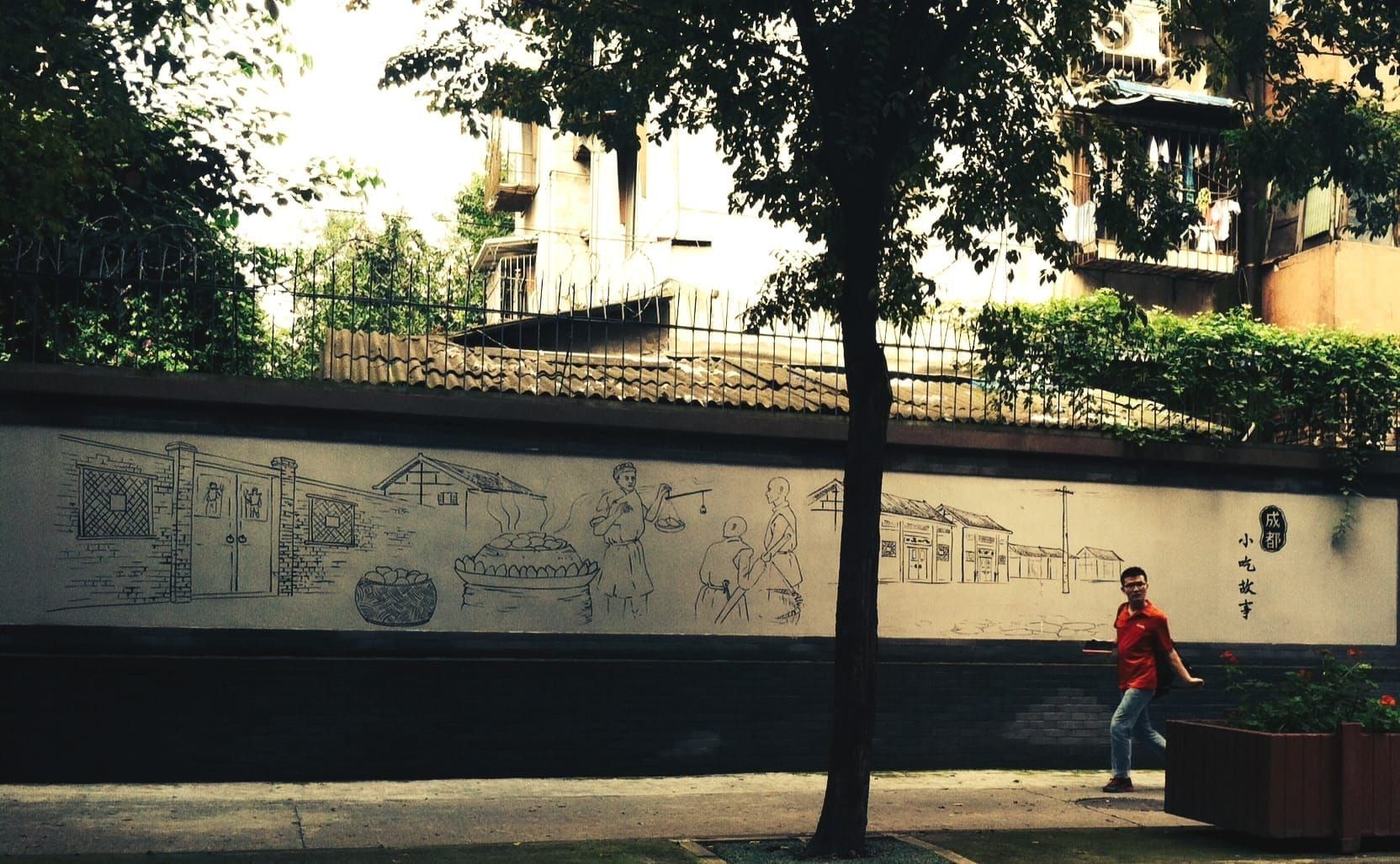
That skinny six-year-old girl blew out her birthday candles inside her old home in Shang Xiao (商校). She had just finished the first semester of elementary school, one affiliated with Sichuan University and located right in the heart of the stunning university campus. She lived with her parents in a tiny one-bedroom, first-floor unit inside a four-story red brick apartment building. About 15 of these old, sturdy apartment buildings inside Shang Xiao - a roughly 15-acre square-shaped residential community just southeast of Chengdu’s city center - were assigned housing units for faculty members of Sichuan University, where her mother worked as a German language instructor for several decades.
Despite a restrained living condition commonplace for so many Chinese families with young children growing up in the early 1990s, she never felt unfree or impoverished. On the contrary, Shang Xiao as a community was so full of vitality, a village in the truest form, a treat for the five senses in all seasons of the year.
When an abrupt “explosion” would periodically be heard in Shang Xiao, we children always knew to follow our noses to the street vendor that had just finished making a bag of yummy popcorn. The popcorn cannons that they used, so popular during my childhood, were such a spectacle. Street vendors usually parked themselves and their elaborate equipment in an open space. From afar, whenever I saw a man sitting on the street calmly spinning the handle of a teardrop-shaped iron container, with fire beneath the container and a giant rubber bag nearby, my heart rate rose immediately. As a passerby and a child, my desire to stop and stare always conflicted with that of running as far away as possible, because no one ever knew when that man would stop spinning the handle and start attaching the rubber bag. But as soon as he did, a crowd had already formed; onlookers young and old alike squinted their eyes, covered their ears, and held their breath. Something so thunderous and so delicious was about to happen: The man discreetly pulled the lever on the container, and “BANG!” Enormous pressure was released, and a new batch of popcorn magically appeared in the rubber bag, sending the warm and nutty aroma of fresh popcorn high up in the sky. Oh, what a feast on a dry winter day in Chengdu!
On a humid summer evening though, smells of mosquito repellent incense enveloped the community. Plugged-in electric devices or burned mosquito coils emitted the most distinct odor that was both fragrant and stifling, an appropriate mix considering their main ingredients derived from flowers that naturally repel insects.
Unlike mosquitoes, germs circulated all year round in a dense community like Shang Xiao. The nauseating scent of freshly boiled Chinese herbal medicine concoctions could only be surpassed by its even more overwhelming taste, but young kids everywhere must reconcile between a nasty bowl of dark-colored, ominous-looking medicinal soup and the wonders it did for curing fever, cough, or runny nose. (A cup of freshly brewed black coffee that my half-Cuban, moka-pot-loving husband adores? Unfortunately to me, it looks, smells, and tastes exactly like freshly decocted Chinese medicine: bitter, pungent, and stomach-turning. Ugh!) Unpleasant medicinal aura spread from household to household, mixed in with but not inhibited by a cacophony of other neighborhood smells from mosquito coils, spices, fried pork lard, and chicken droppings.
That’s right. Chickens, along with stray cats and street dogs, roamed around Shang Xiao all day long. They were nobody’s poultry or pets, but (mostly) peacefully coexisted with humans. On a gorgeous spring day, cats sunbathed, dogs scouted, and chickens munched on anything that seemed edible.
Occasionally, when a blaring car alarm (still a relatively new sound for China in the early 1990s) disrupted the rhythm of the day, animals howled, and children playing outside erupted into screams. But quickly and splendidly, the symphonic roar of woks on high heat stir-frying the beloved twice-cooked pork (回锅肉) drowned out those sudden noises. It was almost lunch time again. A long line formed at a makeshift dumpling stand near the community gate; the woman who folded dumplings there every day started working extra fast. Other street food vendors had been preparing for hours as well, selling out bags and bags of hot and sour noodles (酸辣粉), ciba cakes (糍粑), and tea eggs (茶叶蛋) to construction workers, school children, and retirees. A craftsman packed up his cotton fluffing bow and station, and an enterprising recycling worker on a flimsy bike finished his last song of the morning, his resonant chant heard across the entire neighborhood:
“收废品儿!收旧冰箱,旧电视,收音机!” (“Collect waste items! Collect old fridges, old TVs, and radios!”)
For children growing up in Millbrae or Burlingame in 2025, Shang Xiao may seem chaotic. For children like myself growing up in Shang Xiao in the early 1990s, the community was both home and paradise.
The apartment buildings that steadfastly witnessed the dynamic energy of China in the late 1980s and early 1990s also housed many of my friends from elementary school. As if all the commotions from street merchants, animals, and cars weren’t enough for the bustling community, the crooked, narrow, and tree-lined roads in Shang Xiao regularly transformed into buzzing playgrounds.
Whenever school was off, children of all ages fanned out for all sorts of free play outside. There were no play structures like slides, swings, or seesaws, but that didn’t stop us kids from creating our own. We’d have no problem finding two trees as anchor points for a hammock or a Chinese jump rope (跳橡皮筋); the neighborhood “plaza,” a gathering spot with benches, public bathrooms, and large blue trash cans on one side and a small wooded area on the other, made for a perfect space for hide-and-seek; kids brought toys and games of all kinds, from jianzi (踢键子) to long rope (跳长绳, similar to Double Dutch, but with one rope), from handkerchief (for Drop the Handkerchief game (丢手绢), which much later I found out to be similar to duck, duck, goose) to badminton set, and various games would break out.
Even made-up games sent kids into a frenzy too. One summer, a hazing-like “campaign” swept across Shang Xiao. Younger kids were told by older ones that they shall collect abandoned cigarette boxes in the neighborhood (some hidden in “secret tunnels”), flip open the cover, and discover combinations of code, one of which would win a big prize! Of course, the “campaign” fizzled out at the end of the summer with no prize and lots of dirty hands.
Laughs, screams, chants, and songs often lasted into nighttime all year round; this was when a few parents from different corners of the neighborhood began shouting their children’s names at the top of their lungs, calling home a few particularly mischievous boys (and one girl, not me) for dinner.
Until a certain age, boys and girls played together for the most part, and many games were popular among all children regardless of gender or age. However, certain games like Chinese jump rope and jianzi were widely considered to be girls’ games. Girls would form teams and compete any chance they got, thanks to the light weight and portability of the items needed for the games. Most girls in the neighborhood knew the chants, the routines, and the foot or kick patterns of these games. These early childhood rhythms were so ingrained in my brain that decades later, when I demonstrated a basic Chinese jump rope routine for my toddler on the other side of the world, I immediately recalled the chants and foot patterns, as if they were never forgotten.
Fangtan Lu, an elementary school classmate who also lived in Shang Xiao, was the only boy that regularly participated in the girls’ games. With a clean buzz cut, baby face, medium build, and neutral clothing, his look wouldn’t stand out among any group of young children in a classroom. Where he might stand out was on the playground; he almost never played with other boys or showed any interest in boy-leaning activities like roller skating or ball kicking, but always collaborated seamlessly with girls in Chinese jump rope and jianzi. He was in fact so skilled at these girls’ games (and proudly so) that at an age of intensely separated gender-typed play, girls would prefer him on their own teams over another girl who wasn’t as good. We never found his company strange or off-putting, and naturally welcomed him as a part of us. He blended in perfectly with the smaller, more intimate, and more expressive dynamics of girls’ group play; his personality, the way he carried himself, and his voice and tone, although not flamboyant, seemed more feminine at a young age.
Even though unable to articulate our emerging awareness around gender and sexuality, we school-age children weren’t clueless. Growing up in a conservative East Asian culture, our exam-oriented education system offered zero formal teachings (even the age-appropriate kind) around sexuality and gender identities. Parents rarely provided guidance either, even during the particularly sensitive adolescent years. As a result, kids of all ages resorted to inaccurate (and definitely not age-appropriate) sources like TV shows, gossip, and video games to channel our developmentally-normal exploration around boy-girl-related topics.
I recall distinctly that in second grade, a “popular” girl in my class exclaimed in all seriousness, “My friend didn’t fully understand love until she was in third grade!” Everyone seemed to know who the “Xiao Hua” (校花, prettiest girl in school) or “Xiao Cao” (校草, cutest boy in school) was. The never-ending rumors of “who likes whom” spread like wildfire, but not wild enough to reach the teachers’ office. And a torrent of questions swirled around the entire school when an athletic tomboy dominated in yet another 50-meter sprint during the annual sports meet, “Have you seen her use the bathroom?” “What does she wear at a swimming pool?” “Does she like girls?” “I heard she has a tattoo of her girlfriend’s name on her wrist!”
All of these inquiries occurred during recess and after school when parents weren’t home yet. We children quickly learned to hide the chattering from adults, who would surely consider it inappropriate, distracting, and even morally wrong. I recall in our third-grade Chinese textbook, an overall lovely letter written by a mother to her young son also detailed her concerns for him growing up in late 20th century China; one of the concerns was “homosexuality.” During a moral education class (思想教育课), the teacher casually mentioned the society’s need to stay away from morally corrupted activities such as gambling, stealing, and pornography, only to be confronted by a daring eight-year-old boy’s genuine question, “Is Titanic pornography?” (The movie was released in 1997 and an instant hit in China.) I have no memory of the teacher’s response, only the entire class’ uproar.
One ordinary early evening after school and before my parents returned home, I tuned into the Discovery channel as usual. Instead of a nature documentary about sea animals, the episode centered around the topics of sexual attraction, featuring two American actors exchanging eye contact (and apparently also something called pheromones) in a restaurant. As a confused but curious nine-year-old, I brazenly asked my parents when they got home, “What is sexual attraction?” My dad was stunned for a split second, and then cried out in disbelief, “Ah?? What… what do you mean?!” Awkward and upset, he turned to my mom, who was more involved in my schoolwork, “Where did she learn this?!” My mom asked me more gently, learned about the episode, and explained to my dad, “Oh she just watched the Discovery channel…” To them, Discovery channel documentaries were perfectly educational and proper, but a subset about sexual attraction clearly were not. Once again, I have no memory of my parents’ response afterwards. Neither of them was equipped with the tools or knowledge to turn that moment into any semblance of education.
Beneath the surface of grades, honor badges, and track and field medals hid these clumsy and tender moments of early childhood in Chengdu. But Fangtan, the skilled and steady boy who always played with girls, was never clumsy, even towards the end of elementary school when everyone stumbled towards preadolescence years. Whether he was bullied by boys was unclear to me or ever even crossed my mind, but he was always safe with us girls.
The summer before flying to the United States for college and leaving home for the very first time in 18 years, I was invited to a karaoke party with some elementary school classmates to commemorate the end of our childhood. Fangtan, the boy who played with girls, didn’t show up, and nobody mentioned or even recalled him. He faded from memory as soon as early childhood ended; so did the names of most faces from that day of drunkenly singing in a dimly-lit karaoke room. As newly-minted adults, boys and girls—men and women, I suppose—sat separately first, but put arms around one another for pictures later on, and confessed age-old crushes before most of us bade farewell, likely forever.
During the past 18 years I’ve studied, worked, and lived in the U.S., I spent the first half of my time desperately trying to abandon my past in hope of finding the slightest sense of belonging in a foreign country. The friendships I sought, the romance I chased, the accomplishments I pursued, were all oriented by that false hope. I thought in order to survive, thrive, and form connections here, I must bury the part of myself from there. Blinded by anxiety and culture shock during college, I saw no use for the first 18 years of my life on the other side of the planet, and therefore felt severely behind compared to my American peers at a southern public school. I never once thought of Fangtan and those childhood jump rope routines; they represented my foreignness that deeply unsettled me, and therefore, must be cast aside.
As a result, external validation like “You have no accent at all!” or “You seem so Americanized.” poured in, further distancing my present self from the past.
But what the conscious mind buries always finds refuge in the fertile and meandering river of the unconscious. The mystical river gently (and sometimes not so gently) flows through vivid dreams, uncanny déjà vu, or disjointed internal monologue. It doesn’t stop sculpting the emotional terrain until the conscious mind pays attention, no matter how many years it takes.
The second half of my life in the U.S., hardened fear and anxiety gave way to a more nuanced and honest sense of where I stood in history and on earth. Like a flower unfolding from a bud, dreams of childhood began to surface. Night after night, dreams about school exams (especially math), classroom desks and chairs, childhood faces and images, turned into wildflowers that bloomed along the riverbank after years of drought. The past has been knocking on the psychic door of an ever-changing self and nudging me to come home. It’s been whispering poignant tunes from a seemingly forgotten time:
𝄞 Hey you. Back home, your grandparents died. 𝄞
𝄞 Do you remember the layout of your grandpa’s Xinjin apartment that you used to visit with your cousin? What about your other grandpa who always picked up raw milk from the itinerant milkman every night, right outside his house in Pengzhou? Your mind’s eye can trace the contours of each room and your grandpa’s silhouette, can’t it? All you need to do is close your eyes and allow the tears to flow. 𝄞
𝄞 Listen carefully too. You will hear the captivating vibrato of Erhu, the swift flipping of Xuan paper for another poem, and the clacking sound of Mahjong tiles. When was the last time you attempted to play your grandpa’s Erhu, wrote Chinese calligraphy with your other grandpa, or played Mahjong with your grandparents? 𝄞
𝄞 How could you forget your grandpa’s famous-around-town, satisfyingly savory tea eggs? What an odd juxtaposition with the occasional smell of cigarettes coming out of the bathroom, where he continued to sneak a puff after his lung surgery and decades of chain smoking. Both the eggs and cigarettes disappeared when early symptoms of dementia and depression set in; so did his delightful Erhu songs and larger-than-life presence at the neighborhood Mahjong tables. Towards the last few years of his life, he could no longer maintain his rigid, decades-long 6pm dinner time every single day, as the voices he heard in his head overwhelmed his deep-seated identity as a former soldier. He asked his daughter, your mother, to spread his ashes in the river of his old home after he died, so that his descendants could visit and memorialize him whenever and wherever they saw a flowing body of water. 𝄞
𝄞 And remember how you realized, only in recent years after your other grandpa passed away in 2014, that you wished you had gotten to know him better when he was alive? What a literary, eloquent, and intellectual polymath he was. Because you’d only started to candidly embrace your own creativity after your mid twenties, it was all too late. But you’ll always hold dear the Chinese calligraphy he crafted for you before you left home for the U.S.; the well-preserved historical archive that he showed you of Shi Shi High School that both of you attended, just six decades apart; and the daily Xiang Gong routine that he not only loyally followed but also graciously taught you, a little child. Among a whole family of feisty personalities, he stood out as the most tranquil. He was so consistently mild-mannered that even now, you still couldn’t fathom the trauma that he—a school principal—must have endured throughout the tumultuous decades of early 20th century China… 𝄞
𝄞 You know, your daughter is now with them, some of her great grandparents. Even though she died almost 7,000 miles away from them, earthly distance matters little in their realm. They recognized her immediately a few years ago, and have been taking good care of her ever since. 𝄞
𝄞 What about the men that broke your heart in your twenties but opened your mind to the ingrained relationship patterns rooted in an upbringing you'd pushed aside for so long, but could no longer ignore? Notice too how the dreams and songs from childhood emerged around the same time you married your husband, whose wholehearted love and acceptance carried you to safety, and moved you to fully accept yourself as well? 𝄞
𝄞 Speaking of upbringing, now that your living child is born, you have nowhere to turn but to confront your entire life, first 18 years in China, and the second 18 years in the U.S. Because kids are mirrors, and they bring out things in you that you thought you’d blocked away for decades. They show you, so fully, just how splendidly endowed and deeply broken we all are. Just like you in the 1980s China, your own parents in the 1960s China, and your grandparents in the 1930s China, from the moment your son was born in the 2020s U.S., he’s wired for struggles, but lulled by the soothing melody of Mo Li Hua that you sing to him over and over. What a melting pot of humanity spanning a whole century and two of the most distinct places on earth. 𝄞
𝄞 How are you going to raise him, or re-raise yourself? 𝄞
𝄞 … Look at these children skipping and hopping back home from school. Remember Lin Ling, the boy from third grade who moved all the way to Germany with his parents, Wu Juan, the gal who won every 50-meter sprint, or Fangtan Lu, the boy who played with girls…? 𝄞
The old home is never truly lost.
My son, whether or not you are the boy who plays with girls, you will become someone’s memory from an old home, long after you part ways.
Savoring this story? Subscribe free for monthly essays that stay with you, plus first-year access to The Side View, a private letter about what happens between the published pages. Prefer a one-time contribution? Support here.